Cracked garage floor: which cracks matter and how to fix them
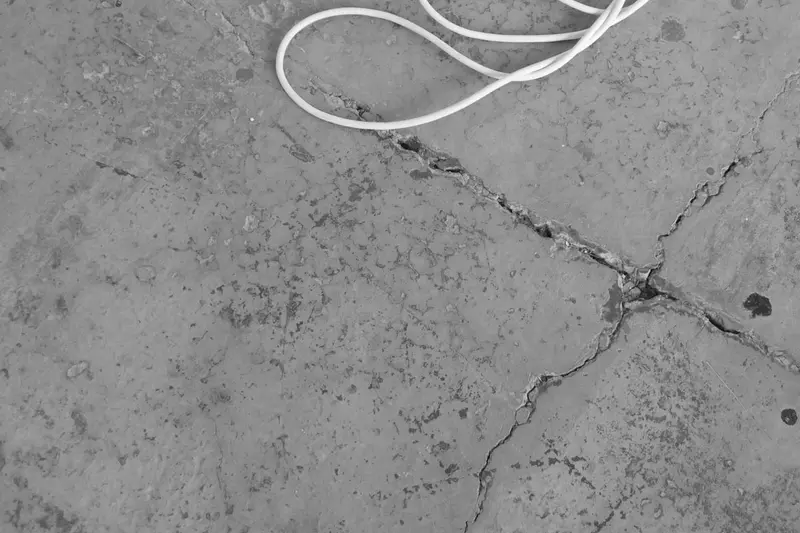
Most garage floor cracks are shrinkage cracks, normal in any slab poured on the ground. A few point to settling or soil problems, and those deserve a closer look before anything is coated.
What you may notice
- Fine hairline cracks across the slab
- Cracks running from inside corners or the garage door
- One side of a crack sitting higher than the other
- Cracks that have widened over time
- Chipped edges along the control joints
Tell us about the floor
Ground, not just etched
Every floor is diamond ground to open up the concrete before it is coated, the step most kits and bargain jobs skip and the main reason coatings peel.
Moisture tested first
Slabs are checked for moisture before anything goes down, because vapor rising through the concrete is what lifts a coating from below.
A written, itemized price
Grinding, crack repair, the coating system and the warranty spelled out line by line in writing, so you know what you are paying for.
Why garage floors crack
Concrete is strong when squeezed and weak when stretched. As a freshly poured slab dries, it shrinks, and the ground beneath it resists that movement, so tension builds until the slab cracks somewhere. Builders cut or tool control joints into the slab to give those cracks a place to happen, but slabs often crack between joints anyway, especially at inside corners, around drains and posts, and where the garage meets the driveway. Later, settling soil, heavy point loads from jacks and lifts, and freezing water can add more.
Normal cracks versus warning signs
Most cracks are cosmetic. These are usually nothing to worry about:
- Hairline cracks you cannot fit a credit card into.
- Cracks that radiate from inside corners or the corners of floor drains.
- Cracks that have not changed in months or years.
These deserve a closer look, and possibly a structural engineer, before coating:
- Cracks wider than about a quarter inch.
- Displacement, where one side of the crack sits higher than the other.
- Cracks that keep growing, or new cracks appearing quickly.
- Matching cracks in the foundation walls, or doors that have started to stick.
Control joints are supposed to be there
The straight lines cut across many garage floors are control joints, not damage. They are designed to crack below the surface where nobody sees it. In a coated floor, joints are either filled with a flexible filler and coated over or carried through the coating as a visible line, depending on how much the slab moves. Chipped joint edges are common where tires roll across them and are rebuilt during prep.
How cracks are fixed before coating
Before coating, each crack is opened with a diamond blade so filler can get into it, vacuumed clean, filled with a rigid or flexible material depending on whether it still moves, and ground flush with the floor. On a flake floor, a well-done repair disappears completely. Concrete crack repair covers the materials and methods in detail.
Why fixing cracks matters even if they are harmless
Unrepaired cracks show through a new coating as lines, collect dirt, and can let water and salt reach the edges of the coating, where it can start to lift. Cracks with broken edges also catch tires and shovels. Repairing them during prep costs little compared with the coating itself, and it is one of the line items to look for on any quote; the epoxy floor cost guide explains how repairs are usually priced.
Monitoring a crack
If you are not sure whether a crack is moving, mark its ends with a pencil and note the date, and measure its width at one spot with a crack gauge or a set of coins. Check again after a season or two. A crack that stays the same width and length is very likely stable. One that grows deserves an expert’s eye before it is filled and coated.
Cracks, car lifts and heavy racks
If you plan to install a car lift or heavy storage racks, have the slab checked first. Many residential garage slabs are only about four inches thick, lift manufacturers specify a minimum thickness and strength, and anchors set close to a crack or joint can break out the concrete around them.
Cracks in the Triangle
The red clay under many Triangle homes shrinks as it dries in late summer and swells after long rains, and slabs built on fill soil or cut into slopes can settle unevenly. Garages on new-construction lots in fast-growing towns like Apex and Holly Springs often show shrinkage cracks in the first couple of years. Most are harmless, but they are worth repairing before any garage floor epoxy goes down.
Cracked garage floor — common questions
Should I worry about cracks in a new house's garage floor?
Usually not. New slabs commonly develop shrinkage cracks in their first year or two as the concrete dries. Note their width with a coin or a crack gauge and check again in a few months; cracks that stay the same are cosmetic.
Can cracks be fixed without coating the whole floor?
Yes, cracks can be filled on their own, but repairs on bare concrete usually show as darker or lighter lines. If appearance matters, filling them as part of a coating job hides them far better.
Why does my garage floor crack near the door?
The edge by the door takes the most weight from tires, the most water and salt, and often has the least support if the soil under the apron settled. Cracks and broken edges there are common.
Other floor problems
Not sure what is wrong with the floor?
Call and describe the floor and what you are seeing, or send a few details and we will get back to you.