Peeling garage floor epoxy: why it fails and what fixes it
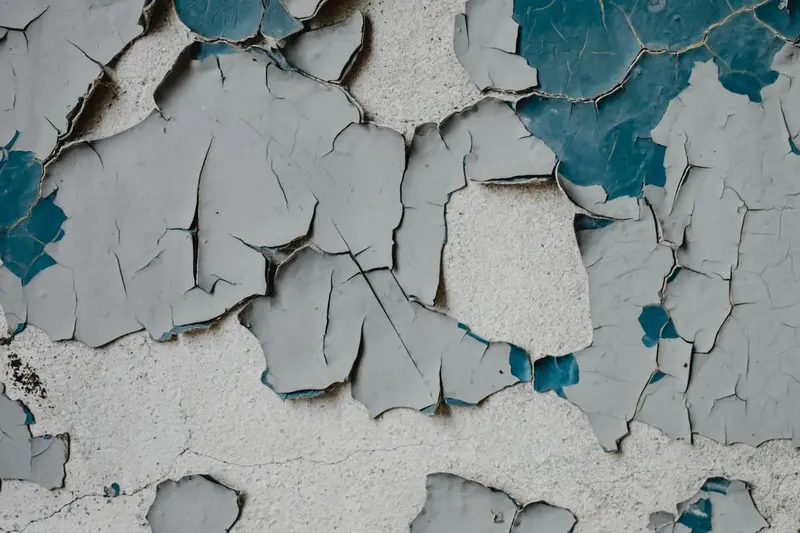
Peeling is a bond failure. Either the coating never gripped the concrete well, or something broke that grip later, and patching the bare spots rarely holds for long.
What you may notice
- Coating lifting at edges, cracks or the garage door
- Patches peeling up where the tires sit
- Coating coming off in thin sheets
- Bubbles or blisters in the surface
- Bare concrete showing in the traffic lanes
Tell us about the floor
Ground, not just etched
Every floor is diamond ground to open up the concrete before it is coated, the step most kits and bargain jobs skip and the main reason coatings peel.
Moisture tested first
Slabs are checked for moisture before anything goes down, because vapor rising through the concrete is what lifts a coating from below.
A written, itemized price
Grinding, crack repair, the coating system and the warranty spelled out line by line in writing, so you know what you are paying for.
Why coatings lose their grip
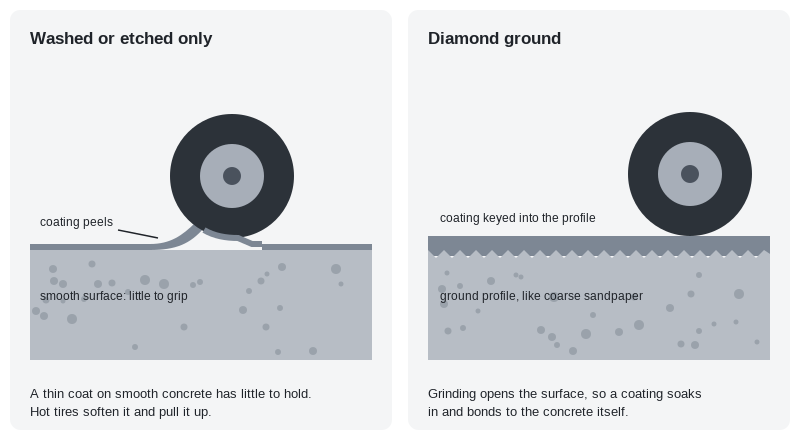
A floor coating holds on in two ways: it soaks into the pores of the concrete, and it grips the texture of the surface. Take away either one and the bond is weak. A slab that was only washed or acid-etched, still carrying a sealer, oil or the smooth troweled skin it was finished with, gives a coating almost nothing to hold. The coating may look fine for months, then start letting go where stress is highest: under tires, at the garage door, along cracks.
The most common causes
- No grinding. The concrete was cleaned or acid-etched instead of diamond ground, so the coating sat on the surface instead of bonding into it.
- A thin or soft coating. Many retail kits are water-based and go on at a small fraction of the thickness of a professional system.
- An old sealer. Many garage slabs were sealed by the builder; coatings do not stick to sealers that were never removed.
- Moisture from below. Vapor rising through the slab builds pressure under the coating and raises blisters that eventually break.
- Oil and contamination. Oil soaked into the concrete keeps primers from bonding.
- Cars back too soon. Parking on a coating before it has cured invites hot tire damage.
- Bad conditions. Coating applied in cold weather, on a damp slab or in high humidity may never cure properly.
Reading the pattern
Where a coating fails often tells you why:
- Under the tires only: hot tire pickup on a thin or under-cured coating; see hot tire pickup.
- Blisters scattered across the floor: moisture vapor or air escaping from the concrete as it warmed during application.
- Near the garage door: water and salt brine working under the edge, often combined with a weak bond.
- Sheets lifting everywhere: a sealer, contamination or no surface preparation at all.
- Along cracks: a crack that was still moving, or one that was never repaired.
What the fix involves
A peeling floor cannot be repaired by covering it. The lasting fix is to remove the old coating completely, find and fix the cause, and start over:
- Remove the coating by grinding it down to bare concrete. Failed coatings often come off quickly, because so little is holding them.
- Test for moisture, especially if there were blisters; see concrete moisture mitigation.
- Grind the slab to open the surface and remove any sealer or oil left behind.
- Repair cracks and pitted areas.
- Coat with a system matched to the floor, cured fully before cars come back.
Epoxy floor repair and recoating covers the process, including floors that only need a fresh topcoat.
Can you fix it yourself?
Scraping off loose coating and recoating with another kit usually repeats the failure, because the surface underneath is still smooth and contaminated. The equipment that makes the difference, a planetary diamond grinder with a dust-collecting vacuum, is what most homeowners do not have. The DIY epoxy kits guide explains what a kit can and cannot do.
Making sure it does not happen again
Ask any installer how the floor will be prepared, how thick the system will be, whether the slab will be moisture tested and how long to wait before parking. Good answers to those four questions prevent almost every peeling floor. The guide to hiring an epoxy contractor has a full list of questions, and concrete grinding and prep explains the step that matters most.
Peeling garage floor epoxy — common questions
Can I just patch the peeling spots?
Patches rarely last, because the coating around the bare spots is usually weakly bonded too. Test the edges with a putty knife; if more lifts easily, the whole floor should be ground back to bare concrete and recoated.
Why is my epoxy peeling only where the tires park?
That is classic hot tire pickup: warm tires soften a thin or under-cured coating and pull it up as the car leaves. It means the bond or the coating itself was weak from the start.
Is peeling covered by a warranty?
Many professional installers warrant against peeling and delamination for a set number of years, but warranties often exclude moisture problems and damage from impact or chemicals. Read what yours covers before you call.
Other floor problems
Not sure what is wrong with the floor?
Call and describe the floor and what you are seeing, or send a few details and we will get back to you.