Commercial epoxy flooring in Cary, NC
Commercial floors take forklifts, carts, chemicals and constant cleaning. The right system depends on the traffic, the spills and how long the business can close, from thin coatings to self-leveling epoxy and urethane cement.
- Warehouses, shops and auto service bays
- Commercial kitchens and food areas
- Self-leveling and high-build systems
- Safety striping and slip resistance
- Scheduling around business hours
Covering Cary · Apex · Holly Springs · Morrisville · Raleigh
Get a quote for commercial epoxy flooring
Ground, not just etched
Every floor is diamond ground to open up the concrete before it is coated, the step most kits and bargain jobs skip and the main reason coatings peel.
Moisture tested first
Slabs are checked for moisture before anything goes down, because vapor rising through the concrete is what lifts a coating from below.
A written, itemized price
Grinding, crack repair, the coating system and the warranty spelled out line by line in writing, so you know what you are paying for.
Why choose us
Floors that stay bonded in garages that get used
A garage floor coating lives with hot tires, road salt, dropped tools and Triangle humidity. Grinding the slab, repairing its cracks, testing for moisture and choosing the right system are what keep it bonded for years.
- Diamond-ground prep
- Moisture tested first
- Cracks repaired before coating
- Epoxy and polyaspartic systems
- Written, itemized estimates
- Local to Cary
Matching the system to the space
Commercial floors range from a small retail showroom to a warehouse with forklift traffic, and the coating has to match what the floor will face:
- Warehouses and distribution: abrasion from forklifts and pallet jacks, impact, and a need for bright, cleanable surfaces with clear aisle markings.
- Auto service and fleet bays: hot tires, oil, brake fluid, solvents and dropped tools.
- Commercial kitchens and food production: hot water, steam cleaning, grease, sanitizing chemicals and thermal shock.
- Labs, clinics and clean spaces: chemical resistance and seamless, easy-to-disinfect surfaces.
- Showrooms, offices and retail: appearance, gloss and easy daily cleaning.
Common commercial systems
- Thin-film coatings of epoxy or polyaspartic, a few coats thick, for light traffic and areas that mostly need cleanability and color.
- High-build epoxy, applied thicker for warehouses and shops, often with a flake or quartz broadcast for texture.
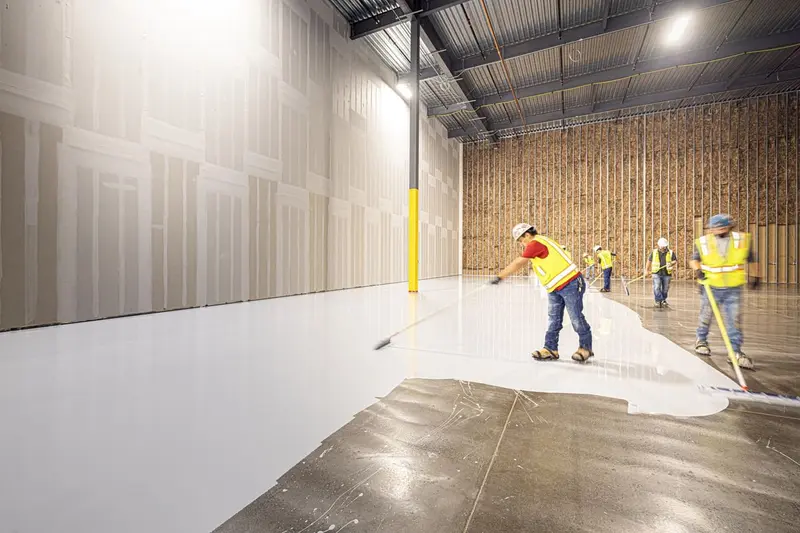
- Self-leveling epoxy, poured and spread to a smooth, flat surface about an eighth of an inch thick, for clean, glossy floors.
- Urethane cement, a tough, trowel-applied system for kitchens, breweries and food plants where heat and moisture would break down ordinary epoxy.
- Polished concrete, no coating at all, for large floors where low maintenance matters most; see polished concrete.
Food areas and health codes
Floors in food preparation areas have to meet health code requirements: smooth, durable, nonabsorbent and easy to clean, with coved bases where floors meet walls in many installations so there is no seam for grime to collect. Urethane cement with an integral cove is a common answer. Coordinate with the local health department and the facility’s own standards before choosing a system.
Safety features
Commercial floors often carry their own safety layer. Grit added to the topcoat improves traction where floors get wet or greasy. Contrasting aisle lines, pedestrian walkways, hazard stripes and machine zones can be coated in during installation instead of taped later. Light colors and glossy finishes also reflect more light, which brightens a warehouse or shop.
Working around a business
Downtime costs money, so commercial projects are planned around the schedule. Fast-curing systems can let a space reopen within a day or two; large floors are often done in sections so part of the building stays in use; and work can be scheduled for evenings, weekends or a planned shutdown. Ventilation and odor matter in occupied buildings, and some products are better suited to them than others.
Prep is bigger on commercial jobs
Commercial slabs often carry years of sealers, curing compounds, oil and old coatings, and large floors are prepared with big planetary grinders or shot blasters connected to industrial dust collection. Moisture testing is especially important on slabs poured directly on grade, and large slabs have more control and expansion joints that need to be honored in the coating; see concrete moisture mitigation and concrete grinding and prep.
Planning for wear
Commercial floors wear in predictable places: forklift turns, dock doors, the path from the kitchen to the dish room. Ask how the system can be maintained, whether worn lanes can be recoated without closing the whole building, and what the warranty covers for normal wear compared with a loss of bond. A floor that gets a fresh topcoat in its busiest lanes every few years lasts far longer than one left until it wears through.
Getting a useful quote
Describe what the floor faces day to day, including chemicals, temperatures, vehicles and cleaning methods, along with how long the space can be closed. A good proposal names the system, its thickness, the prep method and the warranty, and explains why that system fits the use. The guide to hiring an epoxy contractor lists what else to ask.
Commercial epoxy flooring — common questions
What flooring works in a commercial kitchen?
Urethane cement is the usual choice where floors see hot water, steam cleaning and thermal shock, because standard epoxy can crack or debond under those conditions. Health codes require floors in food prep areas to be smooth, durable, nonabsorbent and easy to clean.
How long will the business be closed?
It depends on the system and the size of the floor. Fast-curing polyaspartic and urethane systems can return a space to service within a day or two; thicker epoxy systems may need longer. Large floors are often done in sections.
Can you add safety lines and markings?
Yes. Aisle lines, walkways, hazard zones and parking stripes can be coated into the floor in contrasting colors, and slip-resistant grit can be added where floors get wet.
Often booked with this