Concrete moisture mitigation in Cary, NC
Moisture vapor rising through a slab is the most common hidden cause of coatings that blister and peel. Testing shows how much is coming up, and a moisture-mitigating primer can hold it back.
- Plastic sheet, calcium chloride or humidity probe tests
- Moisture-mitigating epoxy primers
- Drainage and grading problems flagged
- Often needed on basements and older slabs
- Matched to the coating maker's limits
Covering Cary · Apex · Holly Springs · Morrisville · Raleigh
Get a quote for moisture mitigation
Ground, not just etched
Every floor is diamond ground to open up the concrete before it is coated, the step most kits and bargain jobs skip and the main reason coatings peel.
Moisture tested first
Slabs are checked for moisture before anything goes down, because vapor rising through the concrete is what lifts a coating from below.
A written, itemized price
Grinding, crack repair, the coating system and the warranty spelled out line by line in writing, so you know what you are paying for.
Why choose us
Floors that stay bonded in garages that get used
A garage floor coating lives with hot tires, road salt, dropped tools and Triangle humidity. Grinding the slab, repairing its cracks, testing for moisture and choosing the right system are what keep it bonded for years.
- Diamond-ground prep
- Moisture tested first
- Cracks repaired before coating
- Epoxy and polyaspartic systems
- Written, itemized estimates
- Local to Cary
How moisture moves through a slab
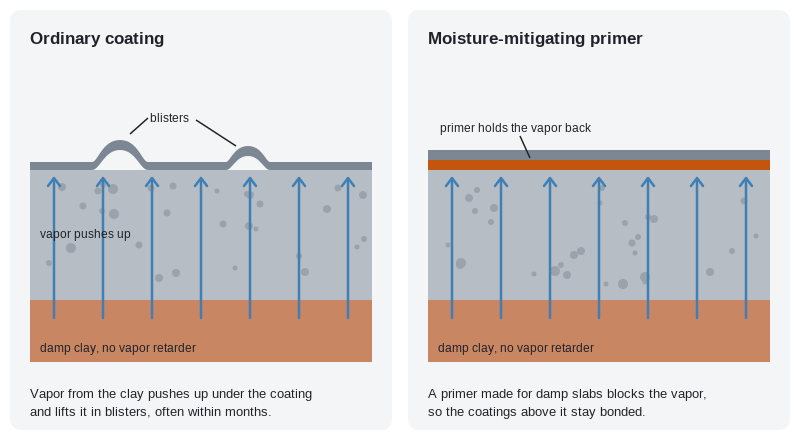
Concrete looks solid, but it is full of tiny capillaries. Water in the soil below wicks up through them and evaporates from the top surface as vapor. On a bare slab, that vapor escapes into the air and nobody notices. Cover the slab with a coating that does not breathe, and the vapor collects under it. Over time, the pressure, along with alkaline salts the moisture carries, can break the bond, raising blisters and eventually lifting the coating off in sheets.
Why it is common here
Triangle soils are largely clay that holds water, and garage slabs are often poured without the plastic vapor retarder that goes under living spaces. Older houses, basement floors, and garages built on low spots or where downspouts drain against the slab are the most likely to show high moisture. Long, wet stretches of weather, like the tropical storm rains that soak the Piedmont some summers, can push moisture readings higher than they are in a dry month.
Testing the slab
- Plastic sheet test. A square of clear plastic, about 18 inches on a side, is taped down on all edges and left for at least 16 hours. Droplets or darkened concrete underneath mean moisture is coming up. It is a screen, not a measurement.
- Calcium chloride test. A dish of calcium chloride sealed under a dome on the bare slab absorbs vapor for a set time and is weighed to calculate the moisture vapor emission rate.
- Relative humidity probes. Sensors set into holes drilled into the slab read the humidity within the concrete, which many manufacturers now prefer because it reflects conditions deeper in the slab.
Each coating has a moisture limit set by its maker, and the test results are compared with that limit.
What mitigation looks like
When moisture is above the coating’s limit, the usual answer is a moisture-mitigating primer: a dense epoxy formulated to bond to damp concrete and resist vapor pressure. It goes down after grinding and repairs, in place of a standard primer, and the rest of the system is built on top of it. These primers cost more and add to the job, but they let a coating be installed on slabs that would otherwise be poor candidates.
What it adds to the job
Mitigation adds material cost and usually an extra coat, and some primers need longer to cure before the next layer goes on. It is still far cheaper than grinding off and replacing a blistered floor a year later, which is why many installers test every slab and price mitigation as its own line on the quote. The epoxy floor cost guide shows how it fits into a typical price.
What mitigation cannot fix
Primers handle vapor, not liquid water. If water pools on the floor, runs in under the garage door, or seeps from a crack or the joint between floor and wall, the source needs fixing first: gutters and downspouts, grading that slopes toward the slab, a failed sump pump or a plumbing leak. Coating over an active water problem only traps it.
Signs your slab has a moisture issue
Dark, damp patches that come and go, white powdery residue on the concrete, a musty smell, and old paint or coatings with blisters all suggest moisture. The damp or sweating garage floor page separates true slab moisture from simple condensation, and white powder on concrete explains efflorescence. If you are coating a lower level, see basement floor epoxy.
Moisture mitigation — common questions
How do you test concrete for moisture?
The quick screen is a plastic sheet taped to the slab for at least 16 hours. For a number, installers use a calcium chloride test, which measures vapor coming out of the surface, or probes set into holes in the slab that read the relative humidity inside it.
Does every garage floor need moisture mitigation?
No. Many garage slabs test fine and take a standard primer. It matters most on slabs without a vapor retarder, basement floors, slabs with dark damp patches or white residue, and floors where an earlier coating blistered.
Can a primer stop water from a leak?
No. Moisture-mitigating primers handle vapor moving up through concrete, not liquid water. Leaks, poor drainage and water coming through cracks or joints have to be fixed first.
Problems this fixes
Often booked with this