White powder on concrete: efflorescence explained
White, chalky or crusty deposits on concrete are usually efflorescence: salts carried up by moisture and left behind when the water evaporates. It is harmless itself, but it is a sign that water is moving through the concrete.
What you may notice
- White powder or crystals on the floor surface
- Chalky streaks on basement or foundation walls
- Deposits along cracks and joints
- Residue that comes back after cleaning
- Paint or coatings blistering nearby
Tell us about the floor
Ground, not just etched
Every floor is diamond ground to open up the concrete before it is coated, the step most kits and bargain jobs skip and the main reason coatings peel.
Moisture tested first
Slabs are checked for moisture before anything goes down, because vapor rising through the concrete is what lifts a coating from below.
A written, itemized price
Grinding, crack repair, the coating system and the warranty spelled out line by line in writing, so you know what you are paying for.
What efflorescence is
Concrete and masonry contain water-soluble salts, from the cement itself, the sand and stone, the soil around them and sometimes the water used in the mix. When water moves through the concrete, it dissolves those salts and carries them toward the surface. At the surface, the water evaporates and the salts stay behind as a white, powdery or crystalline deposit. The name comes from a French word meaning to flower, which is what the white crust can look like as it grows.
Where it shows up
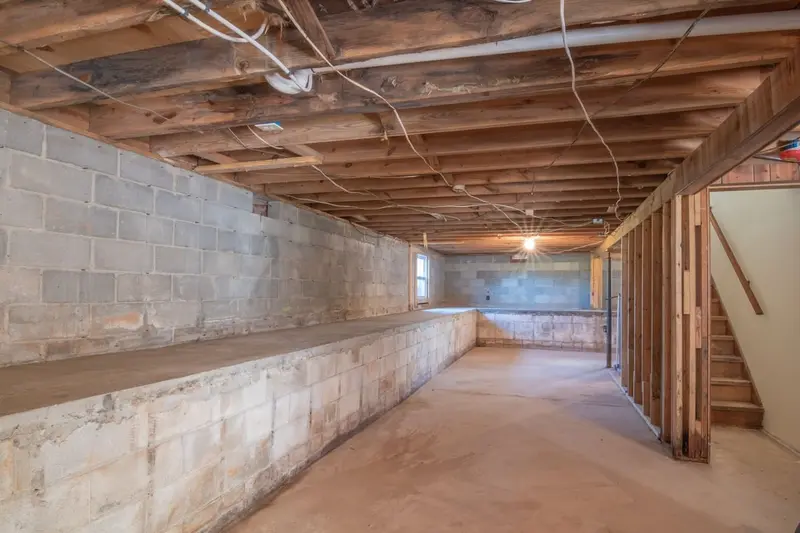
- Basement walls and floors, especially along the bottom of block walls and at the joint between wall and floor.
- Garage floors near the door, along cracks and joints, and in low spots where water collects.
- New concrete, which often shows a light bloom in its first months as construction water dries out. This usually fades and does not return.
- Brick, block and stone on foundations, retaining walls and chimneys.
What it tells you
Efflorescence itself does no structural harm. Its value is as a messenger: it shows exactly where water is moving through or out of the concrete. Persistent or heavy efflorescence on a slab means vapor or water is coming up from below, and on a wall it means water is getting in from outside. For anyone planning to coat a floor, that is important information, because the same moisture that carries salts to the surface will push against a coating.
Telling it apart from mold
Efflorescence and mold both appear in damp basements, and they are easy to confuse:
- Efflorescence is crystalline or powdery, white or grayish, crumbles between the fingers and dissolves when wet.
- Mold is often fuzzy or slimy, may be green, black or white, smells musty, and smears rather than dissolving.
If you are not sure, or if there is a musty smell, treat it as a possible mold problem and have it looked at.
Cleaning it off
Start dry: a stiff nylon or natural-bristle brush and a vacuum remove most efflorescence. Avoid soaking the area with water, which can dissolve the salts and draw them back into the concrete. For heavy deposits, masonry cleaners with a mild acid work well, followed by a thorough rinse and drying time. Expect it to return as long as moisture keeps moving; cleaning is maintenance, not a cure.
Efflorescence and floor coatings
A coating applied over efflorescence sits on loose salt instead of concrete and will not bond. Worse, if moisture is still coming up, salts and vapor collect under the coating, and the result is blisters and peeling, often in exactly the places where the white powder used to appear. Before coating, the deposits are ground away, the slab is moisture tested, and a moisture-mitigating primer is used if the readings call for one. See concrete moisture mitigation and, for lower levels, basement floor epoxy.
White bloom on a new garage slab
Many new homes in fast-growing towns like Apex and Holly Springs show a light white bloom on the garage floor during the first year. That early efflorescence is construction water leaving the slab, and it usually fades as the concrete dries out. It is one more reason to let a new slab cure for at least a month before coating it, and to test its moisture even then.
Reducing it at the source
- Clean gutters and extend downspouts away from the house.
- Regrade soil so it slopes away from foundations and garage slabs.
- Fix irrigation that sprays walls or soaks the ground next to them.
- Repair cracks and joints where water gets in.
The damp or sweating garage floor page explains how to tell whether moisture is coming from below or from the air.
White powder on concrete — common questions
Is efflorescence the same as mold?
No. Efflorescence is mineral salt and dissolves in water; mold is a living growth that is often fuzzy, smells musty and does not dissolve. A few drops of water on the deposit help tell them apart.
How do you remove efflorescence?
Dry brushing with a stiff brush removes most of it. Stubborn deposits can be cleaned with a mild acid cleaner made for masonry, followed by a thorough rinse. It will come back as long as moisture keeps moving through the concrete.
Can you coat a floor that has efflorescence?
Only after the deposits are ground away and the moisture behind them is tested and dealt with. Salts and vapor under a coating are a common cause of blistering and peeling.
Other floor problems
Not sure what is wrong with the floor?
Call and describe the floor and what you are seeing, or send a few details and we will get back to you.